
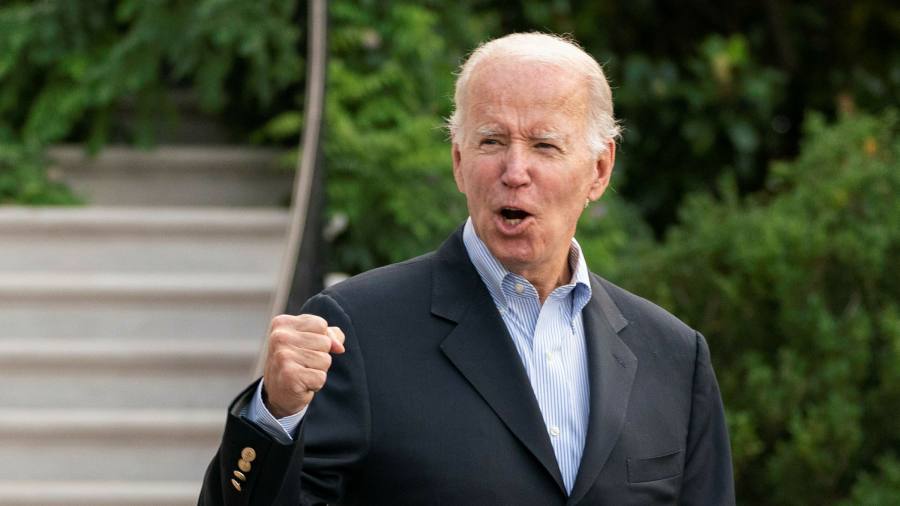
The US Senate approves Biden’s flagship economic package
The US Senate has passed Joe Biden’s flagship economic package after a marathon overnight vote that handed the president a major political victory just months before the midterm elections.
The climate, tax and health care bill, known as the Inflation Reduction Act, passed by a vote of 51 to 50, with the vote split along party lines, with Vice President Kamala Harris casting the deciding vote in an evenly divided Senate.
The bill still needs to pass the House of Representatives and be signed by the president before it becomes law, but its passage through the Senate marks the biggest in a string of recent victories for Biden as he aims to defend slim majorities in both chambers in November.
Earlier this summer, lawmakers voted through bills that provide new subsidies for U.S. chip manufacturing and agreed on bipartisan gun control legislation after deadly shootings in Texas and New York.
The Inflation Reduction Act includes some of the most significant climate legislation passed in the United States, with $369 billion. dedicated to climate and clean energy programs. It also includes new measures allowing the government to negotiate lower prescription drug prices, a provision to apply a tax of at least 15 percent to large corporations and a new 1 percent tax on share buybacks.
However, Kyrsten Sinema, the centrist senator from Arizona, and six other Democrats joined Republicans to vote through a last-minute amendment that would create a carve-out for private equity from the proposed minimum corporate tax.
Business groups and Republicans have fiercely opposed imposing the 15 percent minimum tax, arguing that it would stifle investment and hurt American exporters.
Although most Republican efforts to amend the bill during the long legislative session failed, GOP lawmakers on Sunday morning successfully removed a $35 price cap for insulin from the package. The cap will still apply to Medicare patients.
In a statement, Biden said the bill would “put government back to work for working families” by lowering the cost of prescription drugs, health insurance and daily energy costs while reducing the deficit.
“It took a lot of compromises,” Biden said. “It almost always does important things.”
Chuck Schumer, the top Democrat in the Senate, hailed the bill as “one of the defining legislative achievements of the 21st century”.
“Our bill reduces inflation, lowers costs, creates millions of good-paying jobs and is the boldest climate change package in US history,” Schumer said in a speech on the Senate floor. “This bill will kick-start the era of affordable clean energy in America. It’s a game-changer. It’s a tipping point. And it’s been a long time coming.”
Climate advocates welcomed the passage of the historic bill. “The Senate just made climate history,” said Manish Bapna, executive director of the National Resources Defense Council. “This is the most significant action the United States has ever taken to combat climate change.”
“This bill is not perfect, but from a climate pollution perspective, the positives greatly outweigh the negatives – by a factor of 10,” Bapna said.
Separate analysis by the Rhodium Group, a clean energy consulting firm, estimated that the IRA could put the U.S. on track to reduce emissions by 31-44 percent compared to 2005 levels by 2030, compared with a 24-35 percent reduction without the legislation .
Nancy Pelosi, the Democratic speaker of the House of Representatives, said her chamber would “move quickly” to send the bill to the president’s desk.
The passage of the final bill through the Senate follows weeks of dramatic intra-party negotiations among Democrats, including a surprise reversal from West Virginia Sen. Joe Manchin.
Manchin had refused to back previous versions of the package on the grounds that it would fuel inflation, hurting Democrats’ chances of passing the bill in a closely divided chamber.
However, Manchin and Senate Democratic Leader Chuck Schumer negotiated an agreed bill late last month before winning Sinema’s support last week.
She threw her support behind the bill after Democrats agreed to remove a provision that changes the preferential treatment of private equity and hedge fund profits known as “carried interest.”