
The ruble is rising with undiminished strength, while Russia is considering looser capital controls
The ruble’s sharp recovery picked up on Monday, increasing pressure on Russia to ease key controls on capital flows that have supported the currency’s recovery.
With the gains now threatening to hurt budget revenues and exporters, a decision to cut the share of hard currency earnings that exporters convert to rubles could come as early as this week, according to two people known with the case. The mandatory share could be reduced to 50% from 80% at the moment, said the people, who requested anonymity because the details of the plan are not public.
The ruble’s recovery has left it more than 30% stronger against the dollar than it was before Russia invaded Ukraine on 24 February. Authorities have gradually eased the strict limits on currency operations imposed in the days following the invasion to stem a sharp fall. in the currency.
The restrictions, combined with a collapse in imports amid the extensive sanctions imposed on Russia by the United States and its allies, nearly wiped out demand for foreign currency, and supply rose thanks to high prices for largely unapproved energy exports.
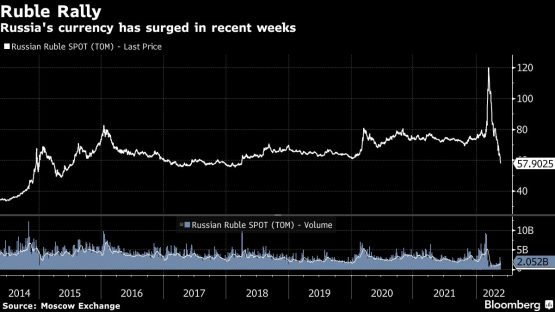
A full “abolition of capital controls would bring the ruble back to the 70-80 range against the dollar, which would be much more comfortable for the economy,” said Tatiana Orlova of Oxford Economics. “This level of the exchange rate is already included in prices. Therefore, returning to this range would not boost inflation.”
The latest struggle with the ruble strength seems to be driven by European companies that comply with President Vladimir Putin’s demand that they switch to paying in Russia’s currency for natural gas.
In just four trading sessions, the ruble has risen 13% against the euro and rose 6.2% to 59.15 on Monday alone. The Russian currency rose 4.1% to 57.8550 against the dollar, ready for its strongest close since April 2018.
Sanctions against the central bank’s reserves mean that it cannot make the currency purchases it made regularly before the invasion. The Tass news service first reported on plans to reduce the requirement for mandatory sales from exporters.
“The ruble is exclusively trade-driven and we are probably sitting on top of the balance of payments surplus,” Commerzbank’s Tatha Ghose wrote in a note on Monday. “Under most scenarios, the exchange rate will be weaker in the coming quarters.”
‘Regulatory burdens’
Still, Russia’s big-business lobby has sounded the alarm about the ruble’s rally, announcing the creation over the weekend of a special working group to monitor the currency situation.
“Excessive regulatory burdens on foreign exchange regulation and control companies should be avoided,” the Russian Union of Industry and Entrepreneurs said in a statement.
Rubles strength is also potentially bad news for the budget, which gets a significant portion of the revenue from energy taxes denominated in foreign currency but spends in rubles.
“The stronger the rate, the bigger the deficit will be,” said Evgeny Kogan, a professor at Moscow’s Higher School of Economics. “And it makes things harder for exporters, increases costs and reduces revenue” in rubles.
“If this lasts for, say, half a year, it will be extremely uncomfortable,” he said, noting that a more “comfortable” rate for the economy would be around 75-80 per cent. dollars.
The press offices of the Bank of Russia and the Ministry of Finance did not immediately respond to a request for comment.
© 2022 Bloomberg