
Nukes in the Brooks: The Artists Who Armed Landscape Art | Art and design
IIt used to be pretty clear what landscape art was. Within the British tradition, it was artists such as Gainsborough, Constable or Turner who provided the standard images of rural surroundings, and from them one could trace a line to the present with a number of artists such as Paul Nash or Eric Ravilious. It was the accepted view well into the 20th century that this tradition – especially the masterpieces of the 18th and 19th centuries – represented something that was somehow safe, firm and broadly reflected the natural course of events.
Radical Landscapes at Tate Liverpool, which, true to its title, has adopted an expanded and inclusive view of what landscape art is, does not surprisingly include Gainsborough’s famous c1750 double portrait of Mr and Mrs Andrews on their large estate. But that includes a video clip of John Berger criticizing the painting in his 1972 television series Ways of Seeing.
Basically, Berger’s argument was that rather than reading the painting as a simple wedding party with the accompanying cornfield symbolizing fertility and so on, this was a bald celebration of property and private land and a statement about who had access to it, and who did. ‘t. As Berger points out, the painting was made at a time when a man who stole a potato risked a public flogging, and the conviction for poaching was deportation.
This spirit of questioning ownership, use, and access to land animates a show that was originally conceived at the height of Brexit debates about identity, belonging, and “taking back control.” Curator Darren Pih was interested in notions of thresholds and borders, as well as the reality that large areas of Britain are out of bounds for most people for a wide range of reasons, from private ownership – including offshore trusts – to militarization and discrimination.

As the exhibition evolved, and after several Covid-related delays, it has moved to examine our relationship to land through the lens of the pandemic, the climate emergency and nuclear threat, as well as more mysterious and emotional ties to the landscape. The links between access to land and class, race, gender and disability are also explored in a specific context of activism and protest.
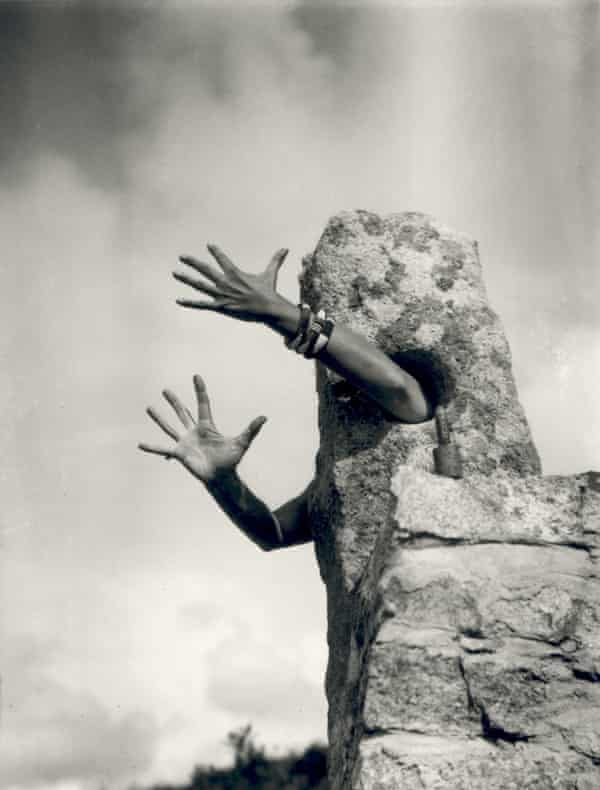
This broad task is fulfilled by a suitably eclectic collection of more than 150 works, largely and imaginatively collected from Tate’s collection and supplemented by some shrewd loans and commissions. The result is pleasantly surprising and diverse. Constable’s very confectionery depiction of Flatford Mill is to be found along with banners made in the 1980s Greenham Common Peace Camp. Claude Cahun’s surrealistic photograph of a pair of arms emerging from a stone monolith sits close to catalogs from the Festival of Britain. There is a study of the resource-efficient life of the Roma community and Peter Kennard’s Haywain with Cruise Missiles montage.
Pih says he “wanted to explore why we have such an emotional attachment to land and why we protest when we see it being threatened”, and while the show nods to the story of the Fences and Highland Clearances in Scotland, its real historical and the political starting point is the busy and then intrusive movements of the early part of the last century, which culminated in the great Kinder Scout violation of 1932 in the Peak District. Led by walkers and young communists, this eventually resulted in the establishment of national parks in Britain.

Although it clearly stems from a genus of older rural protests, these mass violations were largely attempts by the urban working class to gain access to land at a time when cities were polluted and access to green spaces was limited, yet crucial to a good health. The parallels to the pandemic are clear. The violations are represented in the show by 1930s press photographs. Pictures from half a century later, taken by Alan Lodge, of the confrontation now known as the Battle of the Beanfield, between a convoy of new age travelers on their way to the Stonehenge Festival in 1985 and the police, illustrate how the story continues.
The theoretical focus of the Battle of the Beanfield, Stonehenge, resonates around the exhibition with artists – Ravilious, Henry Moore, Tacita Dean and others – attracted by symbolically powerful aspects of the landscape from hangs and geoglyphs to ancient oak trees. Jeremy Deller, who has made films about hangs and whose neon image of the Cerne Abbas giant is in the show along with his acid house smileys made of straw, reflects that “The beauty of most of these places is that there is a sense of shared ownership, physically and conceptually.They are this huge, dumb mirror of Britain.Whatever your views on yourself or your country and humanity, you can project them on to these structures.For me, Stonehenge is the most modern structure in the UK, because every week there seems to be a new story about it. “

After the Battle of the Beanfield, the venues moved to the burgeoning rave scene, which culminated in 1992 at the huge unlicensed gathering in Castlemorton (the show contains rare rave footage), which indirectly led to changes in civil liberties through criminal law. But legal battles over disputed sites and access were only one way to restrict who could or should occupy those seats. Issues of discrimination, exclusion and deletion are much explored in the show.
Ingrid Pollard, whose works have long revealed what has been hidden in common view in the landscape tradition – the absence of black figures – evokes themes of colonization through family photographs. A film made by the neurodiverse collective Project Art Works explores another group that is often excluded from the traditional landscape narrative by following a group of neurodiverse artists, their families and caregivers for several days during a trip to a remote Scottish glen, which in turn expands the view of who has the right to enjoy nature.
For there to be access to the natural world, that world must be cared for. The environmental impact of the show includes a newly commissioned installation by Delaine Le Bas, an artist of Roman heritage – another marginalized society often lacking in landscape history. Rinkeni Pani (Beautiful Water) creates a sense that the artist is using the pictorial conventions of landscape art, Pih explains, “but the work is also about climate change. Le Bass’ grandmother always told her that she should preserve valuable water as part of a nomadic life. “It was also a way of life that valued precious natural resources. It’s a different way of thinking about who is an activist.”

Other large-scale installations include a recently commissioned work by Davinia-Ann Robinson, in which she uses salvaged land to comment on land art as well as colonialism, and Ruth Ewan’s Back to the Fields, her reconstruction of the French Republican calendar, in use from 1793 to 1805 , where plants and objects from nature and country life – twine, a goat’s skull, a tree – represent a single day. A symbolic return of the land to the people, it is also a fascinating challenge for the Tate curators, who have to look after its living plants in a museum’s carefully regulated environment.
Regarding the climate crisis, Gustav Metzger, now seen as a pioneer in environmental art, appears as a central presence in the show with a striking, large-scale photograph from 1998 of the construction of the M3 carving through Twyford Down, Hampshire, surrounded by larval tracks of an earth mover. There is also a liquid crystal display from 1965, powered by ambient heat. Member of the CND’s Direct Action Committee of 100 in the early 60’s, Metzger’s personal connection to humanity’s propensity for destruction – he was sent from Germany to Britain in 1939 at the age of 13 on Kindertransport, and most of his immediate family perished in the Holocaust – greatly influenced his concerns about technology that has the potential to bring environmental destruction.

The show’s broad canvas illustrates well the endless complexity and interrelated issues related to land and landscapes. Perhaps surprisingly, one of the featured artists who best transcends apparent boundaries is Derek Jarman. He is represented by work – assemblage, photography, painting, film – made at Prospect Cottage, the site of his sea garden in Dungeness, Kent. But his career seems particularly apt for a show where activism and rebellion are an inherent part of the relationship between nature and art.
In the 1970s, he had done work in response to Avebury and its standing stones before taking on a more activist and public role to come up with a critique of Thatcherism. When he was diagnosed with HIV and became ill, he retired to his cottage to access nature’s healing and regenerative properties. While there, he created his now famous garden, which in its philosophy, public surroundings and beauty presented itself as a useful example like any radical landscape.