
AI proves a dab hand at pure arithmetic and protein hallucination – TechCrunch
One of many causes synthetic intelligence is such an fascinating discipline is that just about nobody is aware of what it would grow to be good at. Two papers by main labs revealed within the journal Nature immediately present that machine studying may be utilized to duties as technically demanding as protein technology and as summary as pure arithmetic.
The protein factor might not sound like a lot of a shock given the current commotion round AI’s facility in protein folding, as demonstrated by Google’s DeepMind and the College of Washington’s Baker Lab, not coincidentally additionally those who put out the papers we’re noting immediately.
The examine from the Baker Lab reveals that the mannequin they created to grasp how protein sequences are folded may be repurposed to basically do the other: create a brand new sequence assembly sure parameters and which acts as anticipated when examined in vitro.
This wasn’t essentially apparent — you may need an AI that’s nice at detecting boats in footage however can’t draw one, as an illustration, or an AI that interprets Polish to English however not vice versa. So the invention that an AI constructed to interpret the construction of proteins may make new ones is a crucial one.
There has already been some work achieved on this path by varied labs, comparable to ProGen over at SalesForce Analysis. However Baker Lab’s RoseTTAFold and DeepMind’s AlphaFold are method out in entrance on the subject of accuracy in proteomic predictions, so it’s good to know the techniques can flip their experience to artistic endeavors.
AI abstractions
In the meantime, DeepMind captured the duvet of Nature with a paper displaying that AI can help mathematicians in complicated and summary duties. The outcomes gained’t flip the mathematics world on its head, however they’re really novel and really because of the assist of a machine studying mannequin, one thing that has by no means occurred earlier than.
The concept right here depends on the truth that arithmetic is essentially the examine of relationships and patterns — as one factor will increase, one other decreases, say, or because the faces of a polyhedron improve, so too does the variety of its vertices. As a result of these items occur in response to techniques, mathematicians can arrive at conjectures in regards to the precise relationship between these issues.
A few of these concepts are easy, just like the trigonometry expressions we discovered in grade faculty: it’s a basic high quality of triangles that the sum of their inner angles provides as much as 180 levels, or that the sum of the squares of the shorter sides is the same as the sq. of they hypotenuse. However what about for a 900-sided polyhedron in 8-dimensional house? May you discover the equal of a^2 +b^2 = c^2 for that?
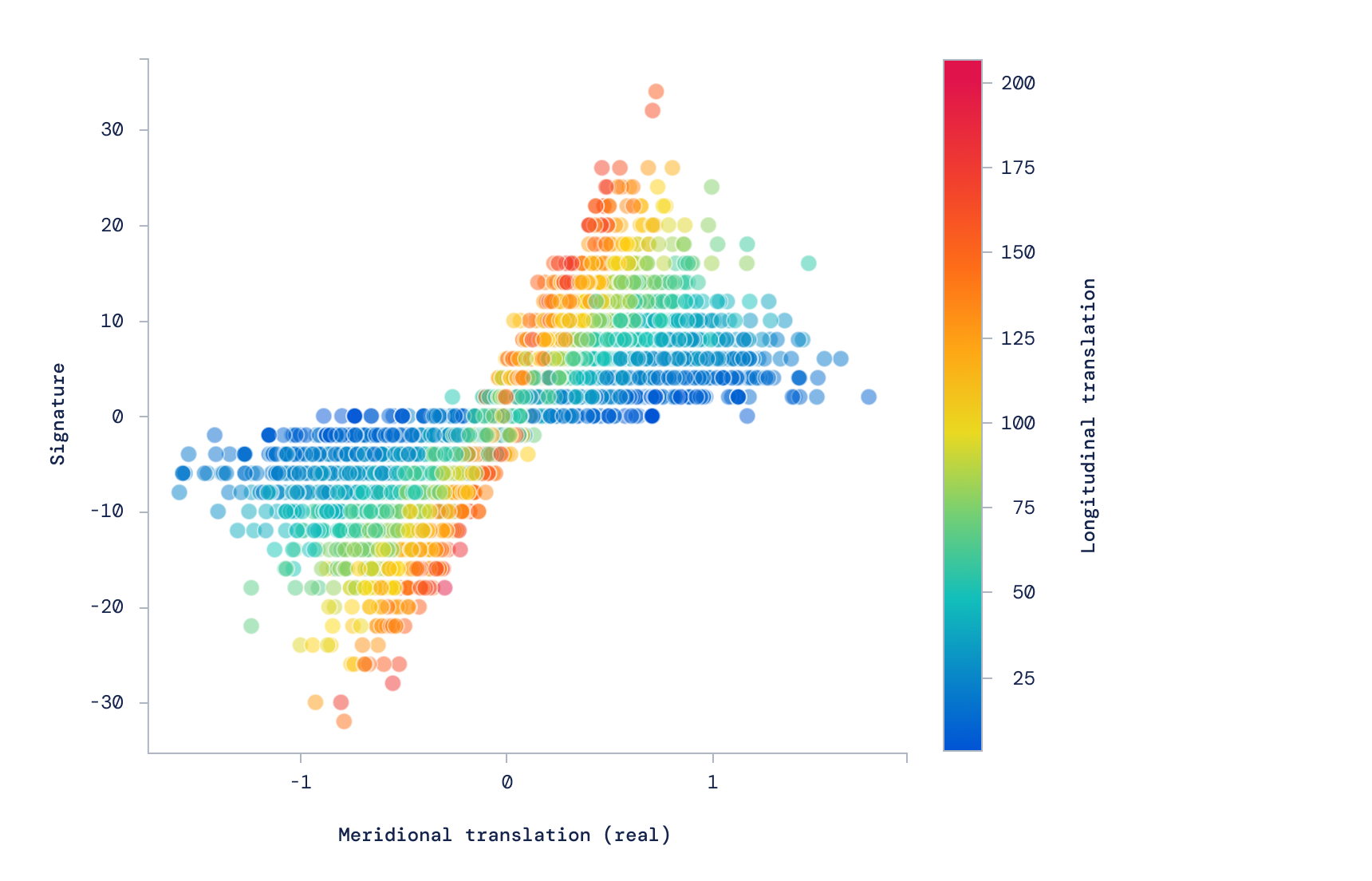
An instance of the connection between two complicated qualities of knots: their geometry and algebraic signature.
Mathematicians do, however there are limits to the quantity of such work they will do, just because one should consider many examples earlier than one can make certain that a high quality noticed is common and never coincidental. It’s right here, as a labor-saving technique, that DeepMind deployed its AI mannequin.
“Computer systems have all the time been good at spewing out information at a scale that people can’t match however what’s completely different [here] is the flexibility of AI to select patterns within the information that might have been unattainable to detect on a human scale,” defined Oxford professor of arithmetic Marcus du Sautoy within the DeepMind information launch.
Now, the precise accomplishments made with the assistance of this AI system are miles above my head, however the mathematicians amongst our readers will certainly perceive the next, quoted from DeepMind:
Defying progress for almost 40 years, the combinatorial invariance conjecture states {that a} relationship ought to exist between sure directed graphs and polynomials. Utilizing ML methods, we had been in a position to acquire confidence that such a relationship does certainly exist and to hypothesize that it is likely to be associated to buildings often called damaged dihedral intervals and extremal reflections. With this information, Professor Williamson was in a position to conjecture a shocking and delightful algorithm that might clear up the combinatorial invariance conjecture.
Algebra, geometry, and quantum principle all share distinctive views on [knots] and a protracted standing thriller is how these completely different branches relate: for instance, what does the geometry of the knot inform us in regards to the algebra? We skilled an ML mannequin to find such a sample and surprisingly, this revealed {that a} explicit algebraic amount — the signature — was straight associated to the geometry of the knot, which was not beforehand identified or recommended by current principle. By utilizing attribution methods from machine studying, we guided Professor Lackenby to find a brand new amount, which we name the pure slope, that hints at an essential side of construction neglected till now.
The conjectures had been borne out with tens of millions of examples — one other benefit of computation, that you could inform it to carefully check your speculation with out shopping for it pizza and occasional.
The DeepMind researchers and the professors talked about above labored carefully collectively to give you these particular purposes, so we’re not taking a look at a “common pure math helper” or something like that. However as Ruhr College Bochum’s Christian Stump notes within the Nature abstract of the article, that it really works in any respect is a crucial step in direction of such an thought.
“Neither result’s essentially out of attain for researchers in these areas, however each present real insights that had not beforehand been discovered by specialists. The advance is due to this fact greater than the define of an summary framework,” he wrote. “Whether or not or not such an strategy is broadly relevant is but to be decided, however Davies et al. present a promising demonstration of how machine-learning instruments can be utilized to assist the artistic strategy of mathematical analysis.”