
“It’s a tough day,” read the email subject line to Shelly Little from her executives at Carvana, an online used car dealer.
The memo signaled that Little was one of nearly 2,500 employees fired from the U.S. company this week, in a mood described by another employee as “mass hysteria.” Since the beginning of the year, the stock of the company, famous for its towering car “vending machines” on several floors, has fallen by 87 percent.
“When the consequences of it start, all I can think about is – wow,” Little wrote on LinkedIn, informing her friends and colleagues that she was one of the 12 percent at Carvana who was shown the door.
Her experience reflects the sudden sobriety that has fallen over the U.S. technology sector, prompted by deep and broad stock sales as investors worry about rising interest rates and declining economic growth.
Privately held companies are forced to adjust their expectations for valuations, access to finance and appetite for venture capitalists among venture capitalists, who may no longer be wary.
“I certainly think it’s humiliating for a lot of people in technology who thought things would never go the other way, or who did not plan a rainy day or were a little bombastic,” said Semil Shah, a founder and general partner at San Francisco-based venture capital firm Haystack.
“If you really counted your chickens before they hatched, or you thought about all the riches that would come to you, it would take a while.”
In the public markets, Carvana has been one of the worst hit, but it is by no means alone. DoorDash, the US market leader in food delivery to restaurants, has fallen by 60 percent year to date. Affirm, which is one of the largest in the formerly very popular buy-now-pay-later sector, has fallen by 85 per cent. Shopify, the e-commerce operator that is regularly considered the most serious threat to Amazon’s e-commerce dominance, has fallen by 77 percent.


Even Big Tech companies, some of the safest growth stocks of the past decade, have suffered major declines. Apple, Amazon, Alphabet and Meta together have seen $ 2.1tn obliterate their market values. In Apple’s case, its $ 600 billion drop was enough to see it dethroned this week by Saudi Aramco as the world’s most valuable listed company.
That an energy giant should take over its cloak is illustrative of the shift in investor confidence from companies with strong top-line growth, but more shaky bottom lines, to those that are safer bets, said Brent Thill, analyst at Jefferies.

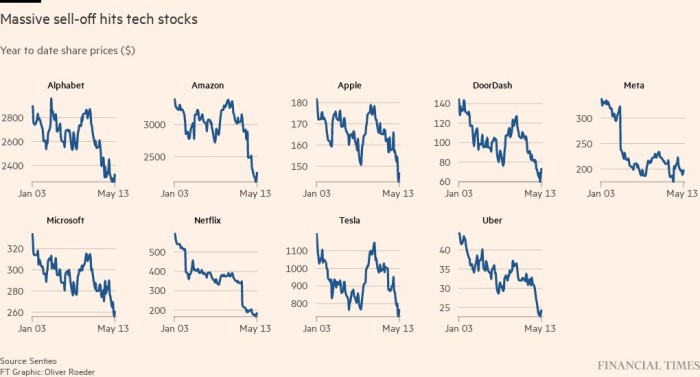
“It’s a full-scale, complete vomit of tech, a full-fledged eject button,” he said. “Less than a year has passed and all high-growth software companies are now evil with no profits. I think it’s a wholesale shift from technology to defensive sectors, energy and utilities.”
Technology companies respond by tackling the basics – reducing costs, reducing spending and focusing on the basics.
“I’ve been talking about free cash flow more than I think since I took my first accounting course, it’s a little wild,” said one person at a major public technology firm.
Similarly, CEO Dara Khosrowshahi of Uber, where shares had fallen 49 percent this year, told staff in a note last weekend: “The goal posts have changed. Now it’s about free cash flow.”
“In times of uncertainty, investors are looking for security,” he added in the memo, first reported by CNBC and confirmed by the Financial Times. “They recognize that we are the scaled-down leader in our categories, but they do not know how much it is worth. When we channel Jerry Maguire, we have to show them the money.”
After dramatically renaming and reorienting his company last year, Meta CEO Mark Zuckerberg’s zeal for the meta-verse has made way for a more clipped enthusiasm for big investments. The social media company last month promised to reduce its spending forecasts by several billion dollars during this year.

To achieve this, Meta has pulled the handbrake on aggressive growth in the number of employees. According to an internal memo from Meta’s CFO David Wehner, which FT has received, it recruited more employees in the first quarter of this year than in the whole of 2021 – but it has come to an end.
“We need to take a fresh look at our priorities and make some difficult decisions about which projects we are pursuing in both the short and medium term to achieve the lower spending guidance we have committed to during earnings,” he wrote and added: “This will affect almost every team in the company.”
Another Meta director’s note said scheduled job interviews for what would have been potential junior and middle-level engineering staff would be “sensitively canceled”.
Twitter, potentially on the verge of taking over Elon Musk, said on Thursday that it had not reached its own “intermediate milestones” for growth, so it “pulls back on non-wage costs to ensure we are responsible and efficient” .
Companies across the technology sector take a closer look at the number of employees as an immediate way to reduce costs. Layoffs.fyi, a site that tracks layoffs among public and private tech start-ups, has registered an increase in early February, although levels are still well below the early stages of the coronavirus pandemic. Delivery “ghost” kitchen start-up Reef, celebrity shout-out platform Cameo and diet and wellness app Noom are among the private companies losing staff.
How technological sales are beginning to affect the private sector and the financing ecosystem that supports it has only just begun to be felt.
According to a report published by the analysis group PitchBook this week, companies that are closest to moving to the public markets and seeking to raise larger rounds have been the first to experience headwinds, and experienced a “very different mood from investors” compared with valuation heights in 2021.
According to CB Insights, global venture capital financing fell by 19 percent in the first quarter of 2022 compared to the previous quarter, the largest percentage decline since the third quarter of 2012. The number of public exits – whether through IPOs or Spac mergers – fell 45 pct.
Haystacks Shah said money for start-ups has already become harder to get for companies without a well-established business model.
“People still write checks,” he said. “But if you raise 500k, or 5mn or 50mn, you have to fight for it – much more than you would have had to fight for it a year ago.”