

Hannah Starkey has educated her digicam on on a regular basis ladies for 25 years. Her pictures embody dreamy ladies, protestors and strident single moms. No matter they’re doing, they’ve a short shimmering radiance that appears to set their total setting aglow. These are works that quietly have a good time ladies and the way they inhabit public house, so within the wake of #MeToo and debates about ladies’s security, it appears a very applicable second for Hepworth Wakefield to stage an investigation. “One factor I’ve realized is that these questions are all the time related,” says Starkey. “They’re pushed again, after which a important mass comes up once more. Girls are actually tenacious.”
Though Starkey’s fashion is harking back to avenue images, she doesn’t work on the hoof, capturing ladies going about their lives. Whereas her photos could derive from one thing she has seen, the works hover between documentary and fiction. The seemingly fleeting moments are crafted with rigorously chosen places and props. The ladies embody associates and other people she approaches on the road.
“I couldn’t simply stick a digicam in somebody’s face: I assumed it was actually intrusive,” she says. “I wanted a system the place everybody was pleased with the method and it wasn’t exploitative. I give somebody my card they usually go and take into consideration the thought first.”
Starkey established herself with a 1997 graduate exhibition on the Royal School of Artwork, the place she pioneered a feminine gaze. In a well-known picture, a woman stares at herself within the mirror of a greasy spoon cafe, misplaced in non-public thought; in one other, two revelers crash into an empty bar, protected in one another’s protecting orbit. At first, nonetheless, she didn’t see ladies as her topic. “I assumed I used to be speaking concerning the human situation,” she says. “As a result of my footage solely depicted ladies, they had been perceived as particular to ladies. There was ghettoization, each of images within the artwork world and ladies in society. It turned a motivation for my total profession.”
Since then, the photographer’s pursuits have developed together with her life. “After I began there was a really male concept that for a feminine artist to achieve success she needed to not have youngsters,” she says. “It was actually unusual to suppose that parenting wouldn’t be an enriching course of. What I study from my two daughters, I feed again into my work and vice versa. I by no means cease trying. I by no means flip off these points [just] as a result of I’ve daughters.”
A recurring concern for her is a very marginalized determine: the only mom. “Moms was a troublesome name so far as the subject material,” she says. “Not cool or horny, over there within the female division or something! However that’s exactly the explanation for doing it.” In Starkey’s footage, moms turn out to be literal pioneers, striding like city cowgirls throughout snow or standing robust within the sharp-edged concrete jungle, a child on her hip.
Images of younger ladies will support the exhibition, from early images taken when she was near the age of her topics to her newest fee from Hepworth, that includes ladies from Wakefield and staged in typical small-town teenage haunts: kebab outlets, cinemas and sweetness parlours. “The challenge was a pure strategy to go in and ask, ‘How’s it going?’” she says. “All my work is mainly asking ladies, ‘How’s it going?’”
The feminine gaze: three extra items by Hannah Starkey

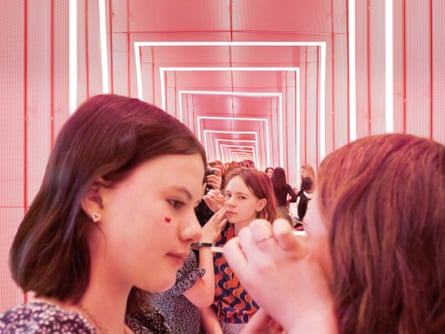
Untitled, 2022
Starkey labored with youngsters in Wakefield, West Yorkshire, to create her newest pictures. “I needed to make footage once more that had been actually empathetic, concerning the pleasures of images and completely different ideas of magnificence; the best way to see your self on this planet another way.”
Magnificence salon, 2022 (most important picture)
On this picture, Starkey explores how “ladies from cradle to grave are co-opted by the wonder trade. It’s a kind of low-cost, countless plastic bottle locations. It’s all mistaken: empty consumerism, the promoting that goes out of its strategy to persuade you that you just want it.”

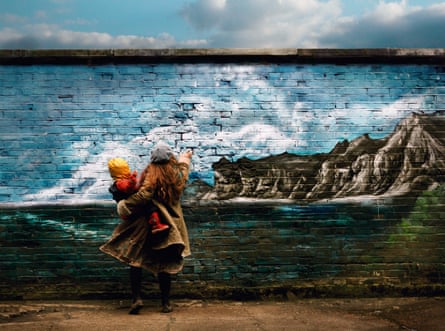
Portrait of a young mother in exile, 2013
Each of Starkey’s images of mothers is intended as a single work, rather than a series: “I’m interested in how one photograph can contain narrative and layers that keep you there for a long time. This depicts a mother in self-imposed exile and the experience of raising a child away from your motherland.”
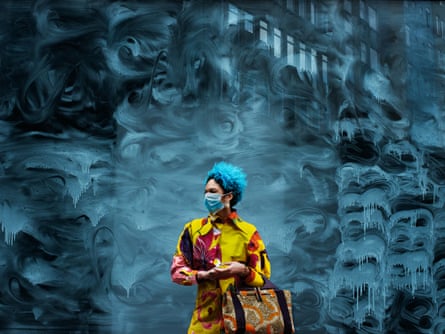
Untitled, 2020
“Sometimes images push their own way into being and the world gives you opportunities. I saw this window in Westminster on the way back from the Black Lives Matter march. Then a few days later this amazing woman walked past me and I approached her. It was an ‘all in camera’ photo [not retouched later].”
Hannah Starkey is at Hepworth Wakefield, to April 30.