
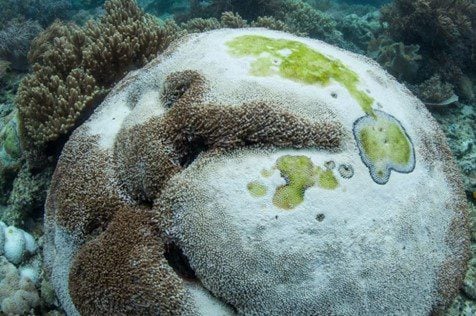
A brand new research means that ships could also be spreading a lethal coral illness throughout Florida and the Caribbean.
The findings by scientists on the College of Miami (UM) Rosenstiel Faculty of Marine, Atmospheric, and Earth Science may assist set up testing and therapy strategies to mitigate the danger of additional illness unfold.
UM mentioned on Tuesday that stony coral tissue loss illness (SCTLD) – which destroys the mushy tissue of not less than 22 species of reef-building corals, killing them inside weeks or months of turning into contaminated – was first noticed close to Miami in 2014 and has since unfold all through all of Florida’s coral reef and into the Caribbean, together with in waters off Jamaica, St. Maarten, US Virgin Islands and Belize.
– Commercial –
Stony coral tissue loss illness (SCTLD) destroys the mushy tissue of not less than 22 species of reef-building corals, killing them inside weeks or months of turning into contaminated.
Researchers counsel that transport via ship hulls, the place the vessel takes on ballast water in a single area to maintain it steady and releases it at a special port, might have contributed to illness unfold.
“Outbreaks in very distant areas counsel that illness transport was aided by means different than simply ocean currents, akin to via ship ballast water,” mentioned the research’s lead writer Michael Studivan, an assistant scientist on the UM Cooperative Institute for Marine and Atmospheric Research (CIMAS) and NOAA’s Atlantic Oceanographic and Meteorological Laboratory.
The UM Rosenstiel Faculty researchers mentioned they carried out two illness transmission experiments within the Experimental Reef Lab on the Rosenstiel Faculty which simulated ship’s ballast water and UV therapy of ballast water to find out if SCTLD pathogens might be transported on this method and whether or not established ballast water therapy approaches akin to UV can efficiently forestall the unfold of illness.
“The outcomes counsel that ship’s ballast water poses a risk to continued unfold and persistence of SCTLD all through the Caribbean and doubtlessly to reefs within the Pacific, and that established therapy and testing requirements might not mitigate the danger of illness unfold,” mentioned Studivan.
The Experimental Reef Lab was designed and constructed by NOAA’s Atlantic Oceanographic and Meteorological Laboratory (AOML) and CIMAS on the Rosenstiel Faculty for conducting analysis on coral response to altering environmental circumstances.
UM mentioned the research, titled ‘Transmission of stony coral tissue loss illness (SCTLD) in simulated ballast water confirms the potential for ship-born unfold’, was printed on November 1, 2022, within the journal Scientific Studies.
CMC/