

In my earlier essay on TechCrunch, I examined the profound challenges which confronted the pc engineers attempting to suit tens of hundreds of Chinese language characters in a reminiscence system designed to deal with a a lot smaller alphanumeric symbolic system.
Now, I flip to the query of Chinese language character output—displays, printers, and associated peripherals—the place nonetheless extra challenges confronted engineers in search of to render Western-manufactured private computer systems and laptop peripherals suitable with Chinese language character textual content.
Whereas we name them “peripherals,” suggesting a form of supporting function, they’re in truth on the very middle of computing in Chinese language, from the acute limitations that Chinese language computing confronted within the Nineteen Seventies and 80s to the immense strides and successes it has skilled from the Nineteen Nineties onward.
Throughout the early rise of shopper PCs within the Eighties, no Western-manufactured private laptop, printer, monitor, working system, or different peripheral was able to dealing with Chinese language character enter or output—not “out of the field,” at the very least. On the contrary, all of those gadgets exhibited the identical sort of English-language and Latin alphabetic bias present in, for instance, the early historical past of telegraphic codes and mechanical typewriters, as I’ve explored in my different analysis.
Throughout the Eighties, what ensued in China and the Chinese language-speaking world was a interval of intense hacking and modding. Component by factor, engineers in China and elsewhere rendered Western-manufactured computing {hardware} and software program suitable with Chinese language. It was a messy, decentralized, and infrequently sensible interval of experimentation and innovation.
Once we flip our consideration to this broader ecology of computing—on printers, displays, and the entire different “stuff” wanted to make computing work—half two of this collection on Chinese language computing spotlights two conclusions.
First, the dominance of alphabet-based computing—“alphabetic order,” as I name it—went far past the query of keyboards and laptop reminiscence. Just like the typewriter earlier than them, computing gadgets, languages, and protocols have been by and huge invented first in English-language contexts, and solely later “prolonged” to different languages and to writing methods aside from the Latin alphabet. To realize even primary performance, Chinese language engineers wanted to always push in opposition to the boundaries of off-the-shelf computing peripherals, {hardware}, and software program.
Second, I’ll dismantle the oversimplified thought of Chinese language “copycatting” and “piracy” that has dominated, then as now, Western accounts of Chinese language computing throughout this pivotal interval within the late Nineteen Seventies and Eighties. When encountering applications equivalent to “Chinese language DOS,” the knee-jerk response within the Western world has been to deal with them as simply extra “Chinese language knock-offs.” What this simplistic narrative fails to know is that with out the sorts of “forgeries” we’ll look at on this article, none of those Western-designed software program suites would have labored in any respect within the context of Chinese language character computing.
Dot-matrix printing and the metallurgical depths of alphabetic order
The primary peripheral we have to look at is the printer—particularly, dot-matrix printers. From the standpoint of Chinese language computing, the politics of dot-matrix printing started with the then-dominant configurations of trade commonplace printer heads—the 9-pin printer heads present in virtually all mass-manufactured dot-matrix printers in the course of the Nineteen Seventies.
These business dot-matrix printers have been capable of produce low-resolution Latin alphabet bitmaps with only one move of the printer head. This was not accidentally, in fact. Moderately, the selection of 9 pins was “tuned” to the wants of low-resolution Latin alphabetic printing.
The identical printer heads, nonetheless, have been incapable of printing low-resolution Chinese language character bitmaps in something lower than two full passes of the printer head. Two-pass printing dramatically elevated the time wanted to print Chinese language as in comparison with English and in addition launched graphical inaccuracies, whether or not as a result of inconsistencies within the development of the platen, uneven ink registration, paper jams, or in any other case.
Aesthetically, two-pass printing may additionally end in characters with differing ink densities on their higher versus their decrease halves. Worse, within the absence of any mod, all Chinese language characters could be at the very least twice the peak of English phrases, irrespective of the font measurement getting used. This created comically distorted printouts during which English phrases appeared austere and economical, whereas Chinese language characters appeared grotesquely outsized. Such print-outs additionally wasted massive quantities of paper, with each doc trying one thing like a large-print kids’s guide.
An instance illustration of how these printer heads work is supplied on this video, courtesy of the creator:
Latin alphabet-centrism ran deeper than one would possibly initially count on, furthermore, as illustrated within the work of early Chinese language computing pioneer Chan Yeh. Getting down to digitize Chinese language characters and basing his system on a bitmap grid of 18-by-22, Yeh’s preliminary thought was an apparent one: to cut back the diameter of the pins in order to suit extra of them on the printer head. As he found, nonetheless, the answer wouldn’t be so easy.

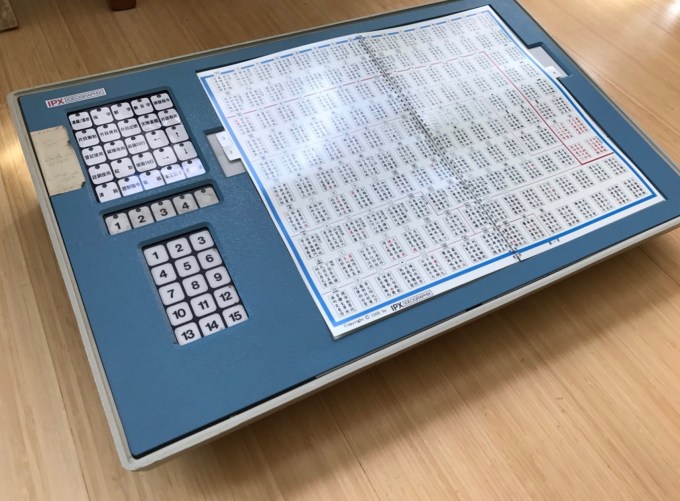
Interface of the IPX machine, invented by Chan Yeh and the Ideographix Company. Picture Credit: Thomas S. Mullaney East Asian Info Expertise Historical past Assortment, Stanford College
The Latin alphabetic bias of influence printing, he discovered, was encoded throughout the very metallurgical properties of printer elements. Merely put, the metallic alloys used to manufacture printer pins have been themselves calibrated to 9-pin Latin alphabetic printing, such that decreasing their diameters to the sizes wanted for Chinese language would end in pin deformation or breakage.
To compensate, engineers tricked Western-built printers into becoming as many as 18 dots in roughly the identical quantity of vertical house as 9 usually spaced dots.
Their approach was ingenious and easy. Following commonplace, two-pass printing, an preliminary array of dots was laid down in the course of the first move of the printing head. Moderately than laying down this second array of dots beneath the primary, nonetheless, they tricked the printer into registering them in between the primary set of 9 dots, virtually just like the tooth of a zipper fastening collectively.
To realize this impact, engineers rewrote printer drivers to hack the printer’s paper advance mechanism, refining it in order that it rotated at an especially small interval (as small as 1/216th of an inch).
Pin configurations weren’t the one problem. Commercially produced dot-matrix printers have been additionally tuned to the ASCII character encoding system, and thus unable to deal with Chinese language textual content as textual content. In English-language phrase processing, printing was not an act of transmitting a raster picture to the printer. Moderately, English-language textual content could possibly be instantly delivered through the printer driver as ASCII-encoded textual content, which resulted in a lot sooner printer speeds.
To ensure that Western-built dot-matrix printers to print Chinese language characters, nonetheless, there was no manner to make use of these printers’ “textual content” mode. As a substitute, the printers as soon as once more needed to be tricked, this time to be able to print Chinese language characters utilizing the graphics mode usually reserved for printing raster pictures.
For college students of the Chinese language language, the irony right here can be obvious: to ensure that Chinese language characters to perform on early Western-built dot-matrix printers, Chinese language characters needed to handled as footage or pictographs. Pictographs have been one thing that Westerners had lengthy assumed Chinese language characters to be, despite the fact that they aren’t (with few exceptions). However within the context of dot-matrix printing, “pictographs” have been certainly what they’d no selection however to change into.
Ultimately, a brand new household of influence printers started to be launched on the business market: 24-pin dot-matrix printers, that includes pin diameters of 0.2 mm (as in comparison with 0.34mm on 9-pin printers). Unsurprisingly, the main producers of those new printers have been largely Japanese corporations equivalent to Panasonic, NEC, Toshiba, Okidata, and extra. Given the necessity to print characters required by the Japanese language, Japanese engineers wanted to resolve comparable challenges as their Chinese language counterparts.
Pop-up modernity: Chinese language character displays

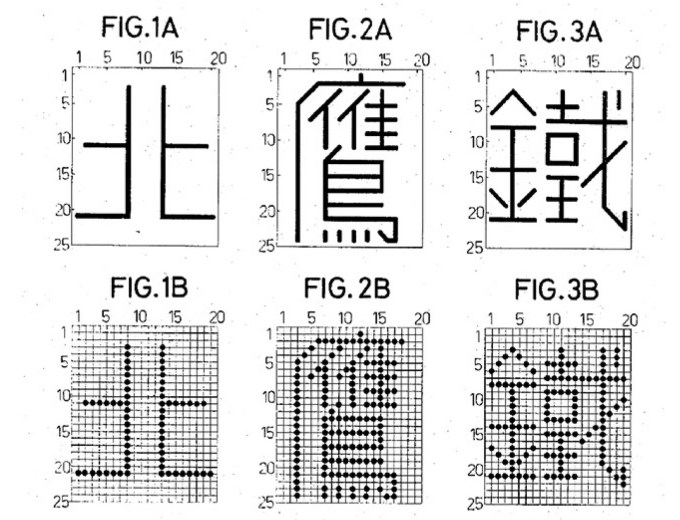
Patent doc picture demonstrating the conversion of Chinese language characters into bitmap rasters. Picture Credit: Thomas S. Mullaney East Asian Info Expertise Historical past Assortment, Stanford College
One more area throughout the ecology of Chinese language computing was that of mass-manufactured laptop displays. In sure respects, the politics of displays have been just like these of printers, significantly close to the problem of character distortion. Unavoidably, even the lowest-resolution Chinese language character bitmaps occupied upwards of twice the vertical and horizontal house of Latin alphabetic letters, making the Chinese language in bilingual texts seem comically outsized (equivalent to might be seen on this story’s featured picture).
Normal, Western-manufactured laptop displays may additionally match a much smaller variety of Chinese language characters on display screen than Latin letters, each when it comes to line size (the variety of characters per line) and depth (the variety of traces per display screen). Chinese language language customers may thus see solely small parts of their texts at anybody time.
Then there have been challenges distinctive to Chinese language character show: the pop-up menu. Due to the inherently iterative strategy of Chinese language enter, during which customers are always being introduced with Chinese language characters that fulfill the standards supplied by their keystrokes, a vital characteristic of Chinese language computing is a “window”—whether or not software-based or hardware-based—that allows the consumer to overview these Chinese language character candidates.
Though the pop-up menu is a ubiquitous characteristic of Chinese language computing from the Eighties onward, this suggestions approach dates again to the Nineteen Forties. In a 1947 experimental Chinese language typewriter designed by Lin Yutang, there was a key part of the machine the inventor known as his “Magic Eye”: in impact, the primary “pop-up menu” in historical past, albeit a mechanical one.
With the arrival of non-public computer systems, mechanical home windows equivalent to these discovered on the MingKwai, Sinotype, Sinowriter, or in any other case, have been built-in into the pc’s most important show. It turned a software-governed “window” (or bar) on the display screen, relatively than a separate, bodily system.
This pop-up menu positioned additional constraints on the already treasured actual property of the pc monitor, nonetheless. What we’d time period “pop-up menu design” turned a critically vital space of analysis and innovation inside Chinese language private computing from its inception. Corporations experimented with completely different menu types, codecs, and behaviors, trying to strike a stability between the necessities of enter, display screen measurement, and the preferences of customers.
There have been trade-offs to every possibility. Menus that displayed a bigger variety of character candidates directly elevated the probability of extra quickly discovering one’s desired graph, however got here at the price of display screen house. Smaller home windows, whereas much less intrusive, required the consumer to scroll by way of “pages” of character candidates, if the consumer’s desired graph was not discovered amongst the highest suggestions.
As a consequence of those strict limitations, Chinese language engineers and companies have been always in search of next-generation displays. Whereas this was maybe true for the worldwide market at massive—since larger decision displays signify one thing of an “inherent good” for customers—however, the motivating causes for this starvation for high-resolution was dramatically completely different for the Chinese language-language market.
Conclusion: No ESC

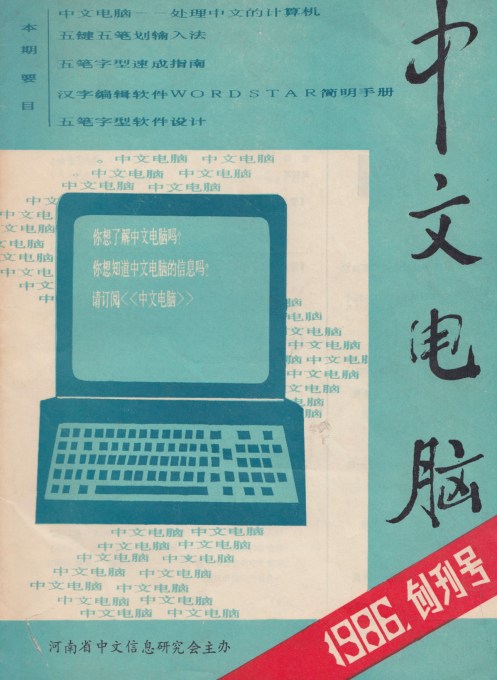
Inaugural subject of the journal “Chinese language Computing”. Picture Credit: Thomas S. Mullaney East Asian Info Expertise Historical past Assortment, Stanford College
As sensible as every of those mods might need been, on the finish of the day they remained simply that: modifications. The autonomy and authority to create authentic methods—that’s, the methods that subsequently wanted to be modified—was finally the place energy was concentrated.
Whereas the observe of modding tended to result in a wide selection of methods, it usually got here on the expense of interoperability. Modding required fixed vigilance, furthermore—no one-time “set it and overlook it” answer was doable.
With each new laptop program launched available on the market—and each new model of each laptop program—programmers in China needed to “debug” them line by line, insofar as applications themselves contained code which may set, or reset, parameters for the pc monitor, for instance.
For many English-language phrase processing applications, for instance, the baseline assumption baked into such applications was a 25-by-80 character show format (zifu fangshi xianshi). Since this format was incompatible with Chinese language character show, engineers needed to manually change each place in this system code the place this 25-by-80 format was set. They did so, tellingly sufficient, utilizing standard-issue “DEBUG” software program. By amassed expertise, engineers steadily realized their manner across the meeting code bowels of main applications.
As soon as modded, furthermore, underlying working methods and applications may all the time change. Shortly after the event of CCDOS and different methods, for instance, IBM introduced its transfer to a brand new working system: the PS/2. “China and Chinese language-language have been thrown into turmoil,” one article from 1987 wrote, noting that no current Chinese language-language methods—whether or not in Taiwan or on the mainland—had but to be tailored to it. “The race is on for builders to give you the perfect match for IBM’s MS/DOS platform.”
From an historic perspective, modders are weak to misrecognition and erasure. Of their time and place, their work was usually misrecognized as mere theft or piracy, relatively than as vital acts of re-engineering to render incompatible machines suitable with the Chinese language language. In a January 1987 subject of PC Journal, for instance, one cartoonist lampooned Sinicized working methods. “It Runs on MSG-DOS,” the cartoon’s caption learn.
As Western producers slowly included many of those Chinese language mods into the core architectures of their methods (in addition to Japanese and different non-Western ones), it’s all too straightforward to overlook that such adjustments have been impressed by the work of engineers in China and the non-Western world. In sum, it’s all too straightforward to retroactively think about that the Western-built laptop has all the time been language-agnostic, impartial, and welcoming.
This essential interval of computing historical past has gone utterly unwritten, and for a quite simple motive. In america, and the Western world extra broadly, none of those mods have been understood when it comes to “experimentation,” not to mention “innovation.” As a substitute, one other set of phrases was—and continues to be—reserved for them: “copycatting,” “mimickry,” “piracy.” As Chinese language engineers reverse-engineered Western-built dot-matrix printers, enabling them to print Chinese language characters; or retrofitted Western-designed working methods to make doable using Chinese language enter methodology editors, all that the majority Western observers may see was “theft.”