
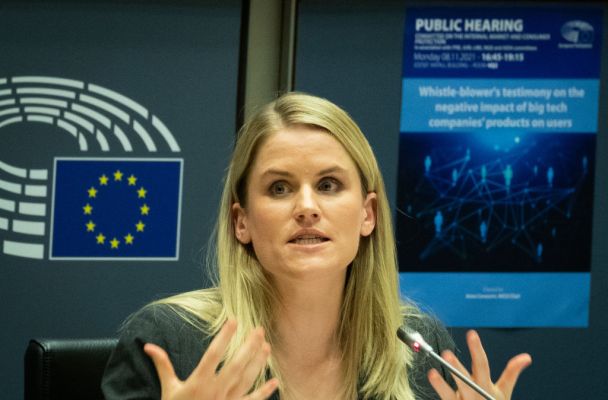
In her newest flip in entrance of a phalanx of lawmakers, Fb whistleblower Frances Haugen gave a refined testimony to the European Parliament on Monday — following related classes in entrance of UK and US legislators in latest weeks.
Her core message was the identical dire warning she’s sounded on each side of the Atlantic: Fb prioritizes revenue over security, selecting to disregard the amplification of poisonous content material that’s dangerous to people, societies and democracy. And that regulatory oversight is thus important to rein in and make such irresponsibly operated platform energy accountable — with no time for lawmakers to lose in imposing guidelines on social media.
The (up to now) highest profile Fb whistleblower received a really heat reception from the European Parliament, the place MEPs had been universally effusive in thanking her for her time — and what they couched as her “bravery” in elevating her issues publicly — applauding Haugen earlier than she spoke and once more on the finish of the almost three hour presentation plus Q&A session.
They questioned her on a variety of points — giving over the most important share of their consideration to how incoming pan-EU digital rules can greatest ship efficient transparency and accountability on slippery platform giants.
The Digital Providers Act (DSA) is entrance of thoughts for MEPs as they’re contemplating and voting on amendments to the Fee’s proposal which might severely reshape the laws.
Corresponding to a push by some MEPs to get an outright ban on behavioral promoting added to the laws in favor of privacy-safe options like contextual advertisements. Or one other modification that’s lately gained some backing — pushing to exempt information media from platform content material takedowns.
Seems Haugen isn’t a fan of both of these potential amendments. However she spoke up in favor of the regulation as a complete.
The final thrust of the DSA is aimed toward attaining a trusted and protected on-line setting — and numerous MEPs talking throughout right this moment’s session spied a soapboxing alternative to toot the EU’s horn for being so superior as to have a digital regulation not simply on the desk however advancing quickly towards adoption slap-bang within the midst of (but) one other Fb publicity disaster — with the glare of the worldwide highlight on Haugen talking to the European Parliament.
The Fb whistleblower was blissful to therapeutic massage political egos, telling MEPs that she’s “grateful” the EU is taking platform regulation severely — and suggesting there’s a chance for the bloc to set a “world gold commonplace” with the DSA.
Though she used an analogous line within the UK parliament throughout one other proof session final month, the place she talked up home on-line security laws in equally glowing tones.
To MEPs, Haugen repeated her warning to UK lawmakers that Fb is exceptionally adept at “dancing with information” — impressing on them that they too should not cross naive legal guidelines that merely require the tech big at hand over information about what’s occurring on its platform. Fairly Fb should be made to elucidate any data-sets it fingers over, right down to the element of the queries it makes use of to tug information and generate oversight audits.
With out such a step in laws, Haugen warned that shiny new EU digital guidelines will arrive with an enormous loophole baked in for Fb to bop by means of by serving up selectively self-serving information — operating no matter queries it must paints the image to get the tick within the field.
For regulation to be efficient on platforms as untrustworthy as Fb, she instructed it should be multi-tiered, dynamic and take steady enter from a broader ecosystem of civil society organizations and exterior researchers — to remain on prime of emergent harms and make sure the regulation is definitely doing the job meant.
It also needs to take a broad view of oversight, she urged — offering platform information to a wider circle of exterior specialists than merely simply the ‘vetted lecturers’ of the present DSA proposal as a way to actually ship the searched for accountability round AI-fuelled impacts.
“Fb has proven that they may lie with information,” she advised the European Parliament. “I encourage you to place within the DSA; if Fb offers you information they need to have to point out you ways they received it… It’s actually, actually necessary that they need to must disclose the method, the queries, the notebooks they used to tug this information as a result of you’ll be able to’t belief something they offer you except you’ll be able to verify that.”
Haugen didn’t simply sound the alarm; she layered on the flattery, too — telling MEPs that she “strongly consider[s] that Europe has a essential position to play in regulating these platforms as a result of you’re a vibrant, linguistically numerous democracy”.
“In the event you get the DSA proper to your linguistically and ethnically numerous, 450 million EU residents you’ll be able to create a game-changer for the world — you’ll be able to pressure platforms to cost in societal threat to their enterprise operations in order that the selections about what merchandise to construct and tips on how to construct them isn’t purely primarily based on revenue maximization. You possibly can set up systemic guidelines and requirements that handle dangers whereas defending free speech and you’ll present the world how transparency, oversight and enforcement ought to work.”
“There’s a deep, deep must guarantee that platforms should disclose what security techniques they’ve, what languages these security techniques are in and a efficiency per language — and that’s the form of factor the place you’ll be able to put within the DSA,” she went on, fleshing out her case for complete disclosure necessities within the DSA. “You possibly can say: You have to be trustworthy with us on is that this truly harmful for a big fraction of Europeans.”
Such an method would have advantages that scale past Europe, per Haugen — by forcing Fb “in direction of language-neutral content-neutral options” which she argued are wanted to deal with harms throughout all of the markets and languages the place the platform operates.
The skew in how a lot of Fb’s (restricted) security funds will get directed towards English-speaking markets — and/or to the handful of markets the place it’s afraid of regulation — is among the core points amplified by her leaking of so many inner Fb paperwork. And she or he instructed Europe might assist deal with this lack of world fairness round how highly effective platforms function (and what they select to prioritize or de-prioritize) by imposing context-specific transparency round Fb’s AI fashions — requiring not only a common measure of efficiency however specifics per market; per language; per security system; even per cohort of closely focused customers.
Forcing Fb to handle security as a systemic requirement wouldn’t solely resolve issues the platform causes in markets throughout Europe however it could “communicate up for individuals who reside in fragile locations on this planet that don’t have as a lot affect”, she argued, including: “The locations on this planet which have probably the most linguistic range are sometimes probably the most fragile locations and so they want Europe to step in — since you guys have affect and you’ll actually assist them.”
Whereas a lot of Haugen’s speaking factors had been acquainted from her earlier testimony classes and press interviews, throughout the Q&A numerous EU lawmakers sought to interact her on whether or not Fb’s drawback with poisonous content material amplification is perhaps tackled by an outright ban on microtargeted/behavioral promoting — an lively debate within the parliament — in order that the adtech big can now not use folks’s info towards them to revenue by means of data-driven manipulation.
On this, Haugen demurred — saying she helps folks with the ability to select advert concentrating on (or no advert concentrating on) themselves, relatively than regulators deciding.
As a substitute of an outright ban she instructed that “particular issues and advertisements… actually must be regulated” — pointing to advert charges as one space she would goal for regulation. “Given the present system subsidizes hate — it’s 5x to 10x cheaper to run a political advert that’s hateful than a non-hateful advert — I believe that you must have flat charges for advertisements,” she stated on that. “However I additionally assume there needs to be regulation on concentrating on advertisements to particular folks.
“I don’t know in case you’re conscious of this however you’ll be able to goal particular advertisements to an viewers of 100 folks. And I’m fairly positive there may be being misused as a result of I did an evaluation on who’s hyper uncovered to political advertisements and unsurprisingly the people who find themselves most uncovered are in Washington DC and they’re radically overexposed — we’re speaking 1000’s of political advertisements a month. So I do assume having mechanisms to focus on particular folks with out their data I believe is unacceptable.”
Haugen additionally argued for a ban on Fb with the ability to use third get together information sources to counterpoint the profiles it holds on folks for advert concentrating on functions.
“With regard to profiling and information retention I believe you shouldn’t be allowed to take third get together information sources — one thing Fb does, they work with bank card corporations, different kinds — and it makes their advertisements radically extra worthwhile,” she stated, including: “I believe it’s best to must consent to each time you hook up extra information sources. As a result of I believe folks would really feel actually uncomfortable in the event that they knew that Fb had a number of the information they do.”
However on behavioral advert concentrating on she studiously averted supporting an outright ban.
It was an attention-grabbing wrinkle throughout the session, given there may be momentum on the difficulty inside the EU — together with because of her personal whistleblowing amplifying regional lawmakers’ issues about Fb — and Haugen might have helped stoked that (however opted to not).
“With regard to focused advertisements, I’m a robust proponent that individuals needs to be allowed to make decisions with regard to how they’re focused — and I encourage prohibiting darkish patterns that pressure folks into opting into these issues,” she stated throughout one response, with out going into element on precisely how regulators might draft a regulation that’s efficient towards one thing as cynically multifaceted as ‘darkish sample design‘.
“Platforms ought to must be clear about how they use that information,” was all she provided, earlier than falling again on reiterating: “I’m a giant proponent that they need to additionally must publish insurance policies like do they offer flat advert charges for all political advertisements since you shouldn’t be subsidizing hate in political advertisements.”
Her argument towards banning behavioral advertisements appeared to boil right down to (or relatively hinge on) regulators attaining absolutely complete platform transparency — that’s capable of present an correct image of what Fb (et al) truly does with folks’s information — i.e. so that customers can then make a real alternative over whether or not they need such concentrating on or not. So it hinges on full-picture accountability.
But throughout one other level within the session — after she had been requested whether or not youngsters can actually consent to information processing by platforms like Fb — Haugen argued it’s uncertain that adults can (at the moment) perceive what Fb is doing with their information, not to mention youngsters.
“With regard to can youngsters perceive what they’re buying and selling away, I believe nearly definitely we as adults — we don’t know what we’ve traded away,” she advised MEPs. “We don’t know what goes within the algorithms, we don’t understand how we’re focused so the concept youngsters can given knowledgeable consent — I don’t assume we give knowledgeable consent and so they have much less functionality.”
Provided that, her religion that such complete transparency is feasible — and can paint a universally understandable image of data-driven manipulation that enables all adults to make a really knowledgeable resolution to just accept manipulative conduct advertisements (or not) — appears to be like, effectively, relatively tenuous.
If we observe Haugen’s logic, had been the instructed remedy of radical transparency to fail — together with by regulator/s improperly/inaccurately speaking all the pieces that’s been discovered to customers and/or failing to make sure customers are appropriately and universally educated relating to their dangers and rights — effectively the chance is, absolutely, that data-drive exploitation will proceed (simply now with a free cross baked into laws).
Her argument right here felt prefer it lacked coherence. As if her opposition to banning behavioral advertisements — and, due to this fact, to tackling one core incentive that’s fuelling social media’s manipulative toxicity — was relatively extra ideological than logical.
(Definitely it appears to be like like fairly the leap of religion in governments world wide with the ability to scramble into place the form of excessive functioning, ‘full-fat’ oversight Haugen suggests is required — whilst, concurrently, she’s spent weeks impressing on lawmakers that platforms can solely be understood as extremely context-specific and devilishly data-detailed algorithm machines; To not point out the sheer scale of the duty at hand, even simply given Fb’s “wonderful” quantities of information, as she put it within the Q&A right this moment, suggesting that if regulators had been handed Fb information in uncooked type it could be far too overwhelming for them…)
That is additionally maybe precisely the attitude you’d count on from an information scientist, not a rights professional.
(Ditto her fast dismissal of banning behavioral advertisements is the type of set off response you’d count on from a platform insider whose experience comes from having been aware of the blackboxes, and centered on manipulating algorithms and information, vs being outdoors the machine the place the harms circulation and are felt.)
At one other level throughout the session Haugen additional sophisticated her advocacy for radical transparency as the only real panacea for social media’s ills — warning towards the EU leaving enforcement of such complicated issues as much as 27 nationwide companies.
Have been the EU to do this she instructed it could doom the DSA to fail. As a substitute she suggested lawmakers to create a central EU paperwork to cope with imposing the extremely detailed, layered and dynamic guidelines she says are wanted to wrap Fb-level platforms — going as far as to recommend that ex-industry algorithm specialists like herself may discover a “house” there, chipping in to assist with their specialist data and “giv[ing] again by contributing to public accountability”.
“The variety of formal specialists in these items — how the algorithms actually work and the results of them — there are very, only a few on this planet. As a result of you’ll be able to’t get a Grasp diploma in it, you’ll be able to’t get a PhD in it, you must go work for one in all these corporations and be educated up internally,” she instructed, including: “I sincerely fear that in case you delegate this performance to 27 Member States you won’t be able to get essential mass in anybody place.
“It’ll be very, very troublesome to get sufficient specialists and distribute them that broadly.”
With so many warnings to lawmakers about the necessity to nail down devilish particulars in self-serving data-sets and “fragile” AIs, as a way to forestall platforms from merely carrying on pulling the wool over everybody’s eyes, it appears instructive that Haugen needs to be so against regulators truly selecting to set some easy limits — comparable to no private information for advertisements.
She was additionally requested straight by MEPs on whether or not regulators ought to put limits on what platforms can do with information and/or limits on the inputs it will possibly use for algorithms. Once more her desire in response to the questions was for transparency — not limits. (Though elsewhere, and as famous above, she did at the least name for a ban on Fb shopping for third get together data-sets to counterpoint its advert profiling.)
In the end, then, the ideology of the algorithm professional could have a number of blind spots in the case of pondering outdoors the blackbox for methods to give you efficient regulation for data-driven software program machines.
Some exhausting stops may truly be simply what’s wanted for democratic societies to wrest again management from data-mining tech giants.
Haugen’s greatest advocacy could due to this fact be her extremely detailed warnings across the threat of loopholes fatally scuttling digital regulation. She is undoubtedly right that right here the dangers are multitudinous.
Earlier in her presentation she raised one other attainable loophole — pushing lawmakers not to exempt information media content material from the DSA (which is one other potential modification MEPs are mulling). “In the event you’re going to make content material impartial guidelines guidelines, then they have to actually be impartial,” she argued. “Nothing is singled out and nothing is exempted.
“Each fashionable disinformation marketing campaign will exploit information media channels on digital platforms by gaming the system,” she warned. “If the DSA makes it unlawful for platforms to handle these points we threat undermining the effectiveness of the regulation — certainly we could also be worse off than right this moment’s state of affairs.”
In the course of the Q&A, Haugen additionally confronted a few questions from MEPs on new challenges that may come up for regulators in mild of Fb’s deliberate pivot to constructing the so-called ‘metaverse’.
On this she advised lawmakers she’s “extraordinarily involved” — warning of the elevated information gathering that might circulation from the proliferation of metaverse-feeding sensors in houses and places of work.
She additionally raised issues that Fb’s give attention to constructing office instruments may lead to a state of affairs by which opting out isn’t even an choice, on condition that workers sometimes have little say over enterprise instruments — suggesting folks could face a dystopic future alternative between Fb’s advert profiling or with the ability to earn a residing.
Fb’s recent give attention to “the Metaverse” illustrates what Haugen dubbed a “meta drawback” for Fb — aka: That its desire is “to maneuver on”, relatively than cease and repair the issues created by its present know-how.
Regulators should throw the levers that pressure the juggernaut to plot a brand new, safety-focused course, she added.