
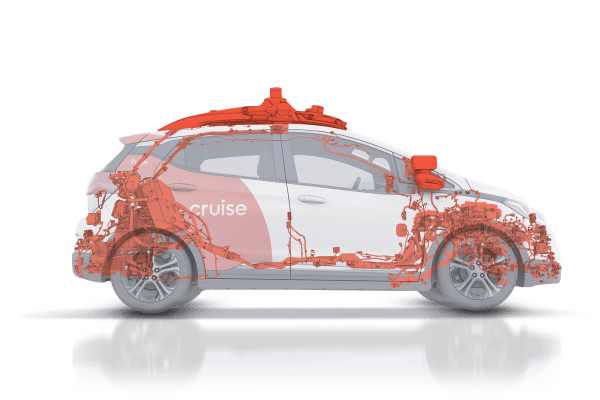
The string of engineers who spoke Thursday night time throughout a deep dive into Cruise’s autonomous car know-how by no means talked about Tesla’s identify. They didn’t must, though the message was clear sufficient.
GM’s self-driving subsidiary Cruise offered a technical and deployment roadmap — at a granular stage — that aimed to point out the way it has constructed autonomous automobiles which can be safer and extra scalable than any human-driven car, together with these geared up with superior driver help methods.
Whereas Cruise was clearly making a case for its personal know-how (to not point out making an attempt to recruit contemporary expertise), the occasion was additionally an argument for autonomous automobiles normally. Every engineer or product lead who spoke Thursday offered numerous elements, from the way it makes use of simulations and the event of its personal chips and different {hardware} to the design of its app and the car itself.
The branded “Below the Hood” occasion constructed off of feedback CEO Dan Ammann made final month throughout GM’s investor day, by which he laid out the corporate’s plan to launch a business robotaxi and supply service beginning with retrofitted Chevy Bolts and ultimately scaling to a military of tens of hundreds of purpose-built Origin AVs on the street over the following few years.
Cruise simply gained approval in California to carry out business supply companies, and remains to be one allow away from having the ability to cost for driverless ride-hailing. Nonetheless, Cruise thinks it’ll be capable of drive down prices sufficient to scale up and out rapidly.
Right here’s how.
Utilizing simulations to scale, not simply confirm the system
Cruise is counting on simulations not solely to show out its security case, but additionally to scale to new cities with out having to carry out hundreds of thousands of miles of assessments in them first.
The corporate will nonetheless must map the cities it enters. But it surely gained’t must remap cities to trace adjustments to the setting that inevitably occur, like lane adjustments or road closures. When Cruise goes to new cities, it begins with a know-how it calls WorldGen, which it says does correct, large-scale technology of whole cities, “from their quirky layouts to the smallest particulars,” which permits engineers to check out new operational design domains, in accordance with Sid Gandhi, technical technique lead of simulation at Cruise. In different phrases, WorldGen turns into the stage the place the longer term simulations are set.
To make sure optimum world creation, Cruise takes into consideration issues like lighting at 24 completely different distinctive instances of day and climate situations, even going so far as to systematically measure mild from a spread of road lamps in San Francisco.
“After we mix a high-fidelity setting with a procedurally generated metropolis, that’s once we unlock the potential to effectively scale our enterprise to new cities,” mentioned Gandhi.
He then laid out the know-how for the “Street to Sim,” which transforms into editable simulation situations actual occasions which were collected by AVs on the street. This ensures that the AV doesn’t regress by testing towards situations it has already seen.
“The Street to Sim combines info from notion with heuristics realized from our hundreds of thousands of real-world miles to recreate a full simulation setting from street information,” mentioned Gandhi. “As soon as we’ve got the simulation, we will truly create permutations of the occasion and alter attributes like car and pedestrian varieties. It’s an excellent straightforward and intensely highly effective technique to construct take a look at suites that speed up AV improvement.”
For particular situations that Cruise hasn’t been capable of acquire in real-world street situations, there’s Morpheus. Morpheus is a system that may generate simulations primarily based on particular places on the map. It makes use of machine studying to robotically enter as many parameters because it needs to generate hundreds of attention-grabbing and uncommon situations towards which it assessments the AV.
“As we work on fixing the longtail, we’ll rely much less and fewer on real-world testing as a result of when you’ve got an occasion that occurs not often, it takes hundreds of street miles to check it correctly, and it’s simply not scalable,” mentioned Gandhi. “So we’re growing know-how to scalably discover large-scale parameter areas to generate take a look at situations.”
Take a look at situations additionally embody simulating the way in which different street customers react to the AV. Cruise’s system for that is referred to as non-player character (NPC) AI, which is normally a online game time period, however on this context, refers to all the automobiles and pedestrians in a scene that symbolize complicated multi-agent behaviors.
“So Morpheus, Street to Sim and NPC AI work collectively on this actually considerate technique to allow us to carry out extra strong testing round uncommon and troublesome occasions,” mentioned Gandhi. “And it actually offers us the arrogance that we will resolve uncommon points now and in future related points, as properly.”
Producing artificial information helps the Cruise AV goal particular use instances, mentioned Gandhi, pointing particularly to figuring out and interacting with emergency automobiles, presumably for no different purpose than to take a dig at Tesla, whose Autopilot ADAS system has come below federal scrutiny for repeated crashes into emergency automobiles.
“Emergency automobiles are uncommon in comparison with different varieties of automobiles, however we have to detect them with extraordinarily excessive accuracy, so we use our information technology pipeline to create hundreds of thousands of simulation pictures of ambulances, hearth vehicles and police automobiles,” mentioned Gandhi. “In our expertise focused artificial information is about 180 instances sooner than amassing street information, and hundreds of thousands of {dollars} cheaper. And with the correct mix of artificial and actual information, we will enhance related information in our information units by an order of magnitude or extra.”
Two customized silicon chips developed in-house
Throughout GM’s investor day in October, Cruise CEO Dan Ammann outlined the corporate’s plan to speculate closely into the compute energy of the Origin so as to lower prices by 90% over the following 4 generations so it might scale profitably. On the time, Ammann talked about Cruise’s intention to fabricate customized silicon in-house to chop prices, however didn’t admit outright utilizing that silicon to construct a chip — however TechCrunch had its theories. On Thursday, Rajat Basu, chief engineer for the Origin program, validated these theories.
“Our fourth-generation compute platform shall be primarily based on our in-house customized silicon improvement,” mentioned Basu. “That is purpose-built for our software. It permits focus and improves processing functionality, whereas considerably lowering piece prices and energy consumption. Compute is a essential system from a security perspective, and has redundancy constructed into it. Add to that an AV system that’s processing as much as 10 gigabits of information each second, we find yourself consuming a good quantity of energy. Our MLH chip permits us to run our complicated machine studying pipelines in a way more targeted method, which in flip helps us to be extra vitality environment friendly with out compromising on efficiency.”
Cruise’s AI group developed two chips: The sensor processing chip will deal with edge processing for the vary of sensors like cameras, radar and acoustics. The second chip, which is designed to be a devoted neural community processor, helps and accelerates machine studying functions like these massive, multitask fashions developed by the AI group. Basu says the machine studying accelerator (MLA) chip is simply the proper dimension to resolve precisely a sure class of neural web and ML functions, and nothing extra.
“This retains the efficiency at an especially excessive stage, and it ensures that we’re not losing vitality on doing something that’s not worth added for us,” mentioned Basu. “It may be paired with a number of exterior hosts or function standalone. It helps single Ethernet networks as much as 25G with a complete bandwidth of 400G. The MLA chip we’re placing into quantity manufacturing is simply the beginning. Over time we are going to proceed to make this even higher-performing whereas lowering energy consumption.”
The Cruise ecosystem
One factor Cruise made clear throughout its occasion is that it hasn’t simply considered the AV tech wanted to scale up efficiently, but additionally your complete ecosystem, which incorporates issues like distant help operators to validate the AV’s choice when it comes throughout unknown situations, customer support, a car that individuals truly wish to experience round in and an app that may effectively and simply deal with issues like buyer help and incidence response.
“To actually cross the chasm from analysis and improvement to a beloved product requires extra than simply synthetic intelligence and robotics,” mentioned Oliver Cameron, Cruise’s VP of product, on the occasion. “A secure self-driving car alone is inadequate and easily step one on a protracted, lengthy journey. To actually construct and scale a aggressive product that’s adopted by hundreds of thousands into their every day lives, you’ll want to construct a number of differentiated options and instruments atop a secure self-driving basis. How these options have to be applied is non-obvious, particularly if your organization’s nonetheless heads-down fixing issues of safety.”