
When Prime Video launched the first teaser trailer for Paper girlsmany were not familiar with Brian K. Vaughan and Cliff Chiang‘s source material was ready to brush it off as the streaming service’s answer Stranger Things. The similarities were there, an 80s adventure that followed a group of Midwestern middle schoolers on bikes battling something otherworldly. Yes, it sounds familiar, but it doesn’t even scratch the surface of what Paper girls really is. There is time travel, giant robots, futuristic societies and an interdimensional villain played by Jason Mantzoukasbut all this sci-fi madness feels like mere backdrop to what is really a deeply human story about growing up and learning to face our insecurities.
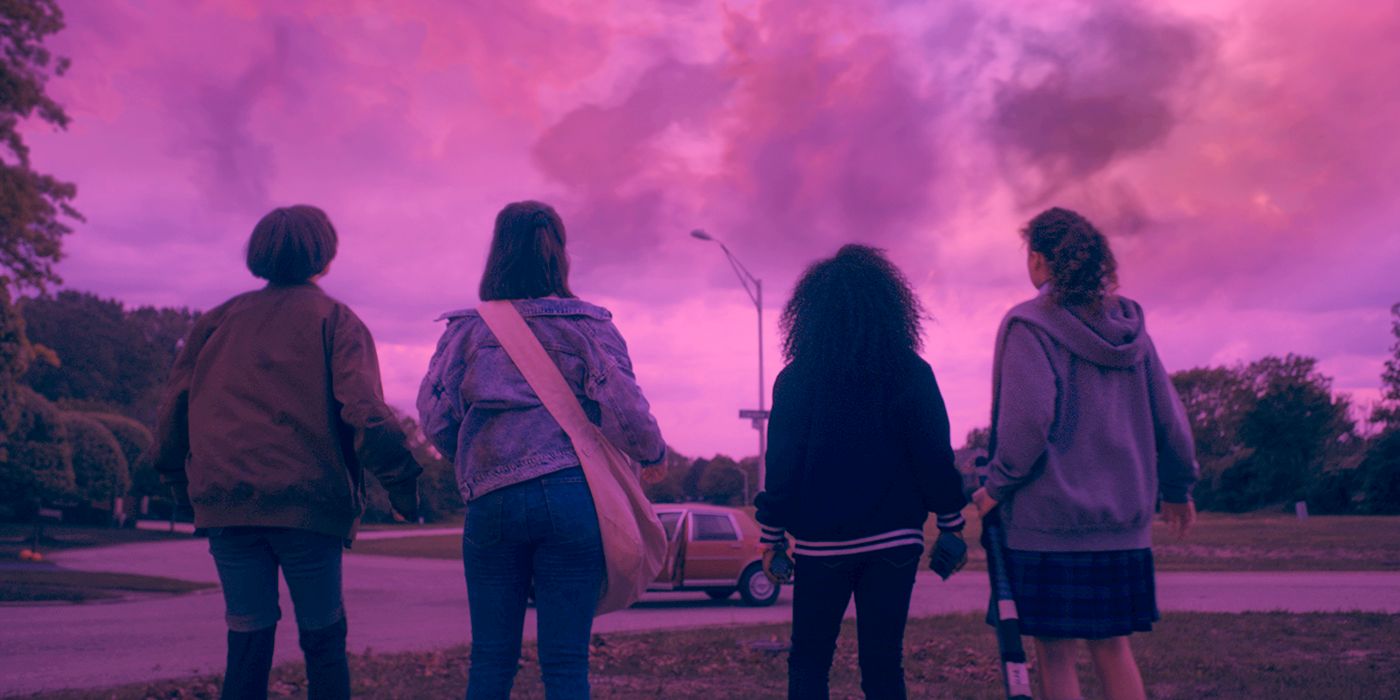
Paper girls begins on November 1, 1988, where four young paper girls embark on what should be just another day at work. There’s the new girl Erin (Riley Lai Nelet), Tomboy Mac (Sofia Rosinky), the wise high priest Tiffany (Camryn Jones), and the private school girl KJ (Fine Strazza), each carrying their own set of struggles, and their bigger personalities often lead to them butting heads. However, the first episode doesn’t take long for things to go sideways as the four girls notice that the sky has turned pink and everyone but them has seemingly disappeared. After a series of unexpected and surreal events, the girls suddenly find themselves in the year 2019 and caught in the middle of a high-tech war between two groups of time travelers. With nowhere else to go, the girls soon come face to face with the grown-up Erin (Ali Wong), and it is from this moment Paper girls is really starting to show its true colors.
Paper girls works best when confronting the more grounded and emotional elements of family drama, sexuality, loss and self-love. As the girls each meet their future selves, we begin to learn more about the burdens they feel they carry. Erin, who is Chinese, had always tried to act as the leader in her family after her father’s death, especially since her mother can barely speak English. It is through this story involving both Erins that we learn of her close bond with her younger sister Missy (Jessica Van) and what becomes of it. Mac, the most rebellious of the group, struggles to come from a broken home, while Tiffany and KJ struggle with the weight of their parents’ enormous expectations.


It is these quieter and subtler moments when Paper girls turns out to be the most engaging. Even after the first episode, we still don’t know much about our four main characters, but it’s through the next seven that the show pulls back the curtains and allows the audience to really feel and relate. When these sci-fi elements kick in, however, the series begins to show its cracks. It might be easy to complain about the VFX work, but it wouldn’t have been nearly as noticeable if the exposition-heavy moments were delivered in a way that felt more balanced. All of this makes the pacing feel a bit off, and despite most of the episodes running under 50 minutes, the series can feel start and go at times, especially in the last four episodes.
When the series’ central antagonists are eventually brought in, they often feel like an afterthought. The menace they are supposed to have is never really felt, which is not the fault of the actors, as both Mantzoukas and Adina Porter breathe a lot of life into their respective roles, but once the credits roll at the end of the finale, they ultimately feel like afterthoughts, and the way their characters are incorporated feels representative of what didn’t quite work in the first season relative to its strengths.

The four young performers at the center of the series are excellent in their respective roles, Rosinky and Jones each exploding with huge amounts of charisma and personality, while Nelet and Strazza deliver more subdued work that makes their characters’ arcs feel all the more. effective. Their dynamic is different than what some viewers might expect; In contrast to Stranger Thingswhere the young protagonists are already friends at the start, the first season of Paper girls tries to show that our main characters learn to trust and love each other, even though they all live very different lives. The fact that the series goes out of its way to show how accepting the girls are of each of their differences feels refreshing and compelling.
In addition to our four main roles, the adult ensemble also impresses. Wong, who is best known for his stand-up and roles in comedies such as Always be my maybe, proves that she is more than capable of delivering some strong dramatic work. She’s not the confident character who drops one-liners left and right; instead, she is a character drowning in her own insecurities and guilt, and it is through her scenes with the four leads that the audience begins to bond with her. By the time her character’s arc ends, some will find themselves wanting more of her presence. Newcomer Sekai Abenì is another big standout as the grown-up Tiffany, giving a complex performance that juggles an extroverted and electric personality with a tinge of dullness. Other permanent presences include Cliff Chamberlain as Dylan, Mac’s adult older brother who acts as a father figure to her in the second and third episodes, and Nate Corddry as Larry, an eccentric recluse who has prepared for the cracks in time.
Paper girls have much more in common with something like Back to the Future or even The Umbrella Academy than it does with Stranger Things. At its core, Paper girls is a coming-of-age story that anyone can relate to. It’s a story of family, perseverance, confronting our insecurities, and embracing what makes each person different, all in the midst of a sometimes overly ambitious story about time travel .
Evaluation: B
Paper girls now streaming exclusively on Prime Video.